
Last updated: 14 November 2026.
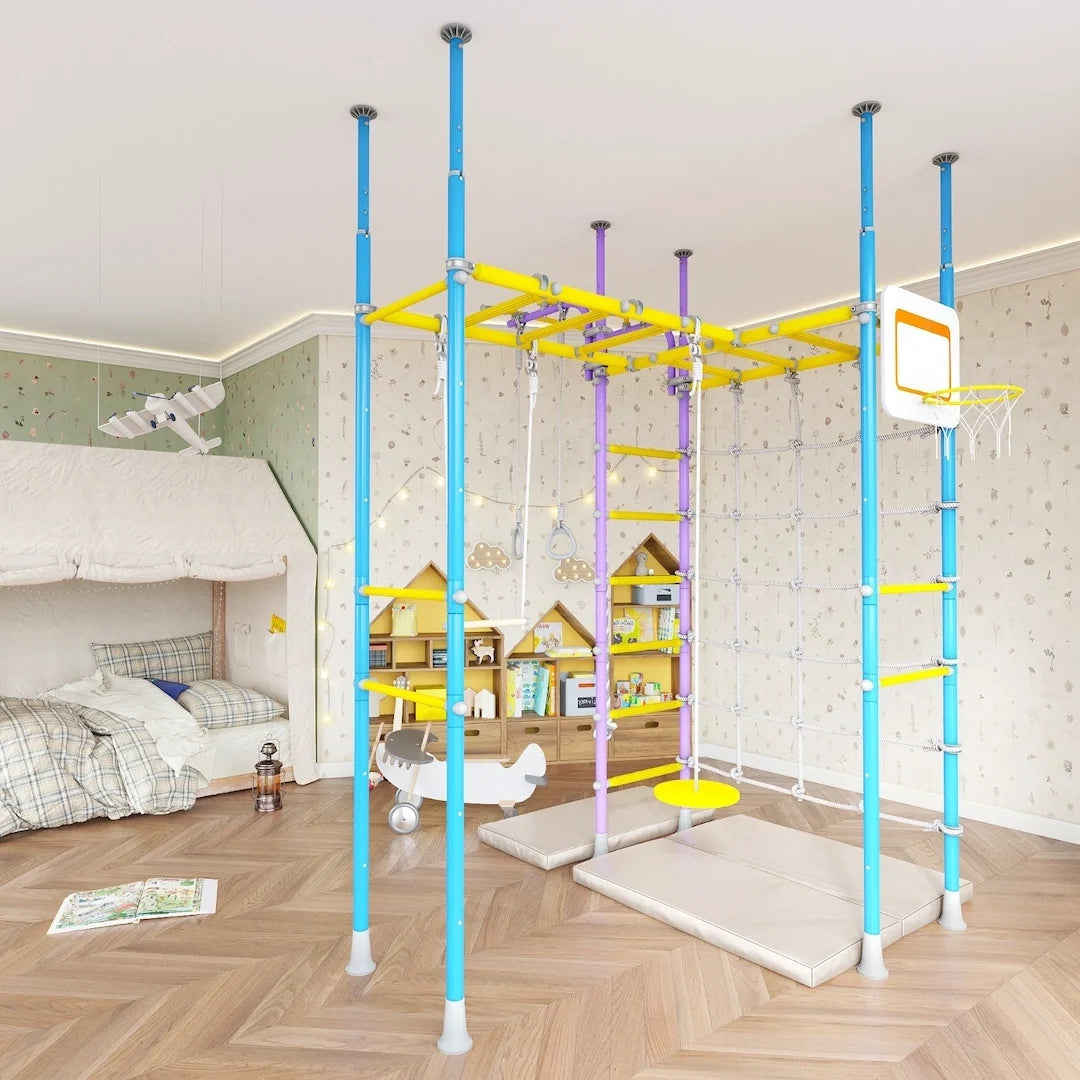
Quick answer: True freestanding monkey bars are rare indoors, because a frame tall enough to hang from needs a wide base or anchoring. Most Australian homes are better served by tension-mounted no-drill frames from 2.25 m ceilings, or low freestanding climbers for toddlers. Tinnitots, an Australian-owned store in Melbourne, sells both.
If you have searched "freestanding monkey bars Australia", you probably want one of three things: no holes in the walls, something you can move, or something that does not need the ceiling. Those are different needs with different answers. This guide sorts out which one you actually have, so you buy once.
Are freestanding monkey bars a real option for indoors?
Mostly no, at least not at full height. Monkey bars put a swinging child above head height, and that swinging pushes the frame sideways. Outdoors, play equipment handles this by being fixed down: the Royal Children's Hospital Melbourne says playground equipment needs to be firmly set into the ground to ensure it is stable, with soft-fall material underneath.
Indoors you cannot dig footings into the lounge room floor, so a tall frame has to get its stability from somewhere else. There are three ways to do that:
- A very wide base (a true freestanding frame). It takes a lot of floor and still needs to sit level.
- Floor-to-ceiling tension (no-drill). The frame is pressed between a flat, fixed floor and ceiling, so it can be narrow and leave no holes.
- Wall mounting (screwed into studs). Very solid, but needs drilling and, for renters, written permission.
Tinnitots monkey bars use the second or third method. None of them are freestanding, and we would rather say that plainly than have you discover it on delivery day.

Freestanding vs no-drill vs wall-mounted: which one do I actually need?
Start with the reason you searched "freestanding". The table below matches the reason to the setup that solves it.
| If your main worry is… | Best fit | Why | Watch-outs |
|---|---|---|---|
| No holes in a rental | Tension-mounted no-drill frame | Nothing is screwed into walls or ceiling | Needs a flat, fixed ceiling in the right height range |
| Low or sloping ceiling | Wall-mounted bars, or a low freestanding climber | Tension frames need a ceiling to press against | Wall mounting needs studs and permission if renting |
| Child under 3 | Low freestanding climber (Pikler triangle, climbing playhouse) | Low height suits early climbers | Use on a soft but sturdy surface, never concrete |
| Moving it between rooms | Freestanding climber, or a tension frame you re-install | Freestanding pieces can fold or shift | Tension frames must be re-checked after every move |
| Smallest floor footprint | Tension-mounted frame | Tall but under 1 m² on the smaller models | Allow clear space around it for falls |
For the full renters angle (bonds, landlord conversations, removal), read our no-drill monkey bars guide for renters and apartments. If floor space is your main problem, our narrow and compact monkey bars guide compares footprints in detail.
How high should climbing equipment be for my child's age?
Raising Children Network gives simple height guidelines for play equipment:
- Younger than 3: try to stick to equipment less than 1 m high.
- 3 to 5 years: less than 1.5 m high.
- Older than 5: no higher than 2 m off the ground.
The same page notes the most common serious playground injuries are fractures and dislocations, which happen when children fall from equipment such as monkey bars and climbing frames. That is the real reason this matters: for under-3s, a genuinely freestanding low climber is often the better buy than any monkey bar, freestanding or not. Raising Children also points out that falls are the most common cause of injuries in every age group in Australia.
What can I do at home before buying anything?
Plenty. Try these free steps first; they also tell you what kind of frame your child will actually use.
- Measure the ceiling in three spots where a frame could go. Note anything uneven, a bulkhead, or a downlight in the way.
- Check the floor. Concrete or tiles need thick mats under any climber. The Pikler triangle page specifically says not to use it on concrete or hard flooring.
- Mark a 1.5 m circle with masking tape around the spot. Kidsafe NSW guidance for moveable play equipment sets a minimum impact area of 1,500 mm around it. If furniture sits inside that circle, it is the wrong spot.
- Watch what your child climbs now. Couch backs and benches suggest a low climber; hanging from door frames suggests they are ready for bars.
- Build a floor obstacle course with cushions, a low step and a line of tape for balance. It is free and shows you how much space active play really takes.
For more ideas on redirecting a determined little climber, see our guide to safe ways to let toddlers climb at home.
How Tinnitots can help
Tinnitots is an Australian-owned store based in Greensborough, Melbourne. Below are the in-stock options that answer the "freestanding" search honestly: no-drill frames for bigger kids, and true freestanding climbers for little ones. Prices are as listed on our product pages today.
No-drill (tension-mounted) monkey bars and climbing frames
These metal frames meet European standards, carry a 200 kg frame load rating (accessories up to 50 kg) and come with a 36-month frame warranty.
| Product | Price | Footprint (standard setup) | Ceiling range | Age |
|---|---|---|---|---|
| Sensory Swedish Climbing Frame – No Drill | $649.00 | 86 cm W x 76 cm D | 2.29 – 2.8 m | 3 years+ |
| Indoor Climbing Ladder & Cargo Net Bundle – No Drill | $874.95 | 1.74 m wide | 2.3 – 2.8 m | 3 years+ |
| Swedish Home Play Gym Set – No Drill | $1,199.00 | 2.04 m x 0.86 m | 2.25 – 2.8 m | 3 years+ |
| Monkey Bars Jungle Gym Bundle – No Drill | $1,825.95 | 2.03 m x 1.8 m | 2.25 – 2.8 m (up to 3.0 m with Height Extension Kit) | See product page |
All four install between a flat, fixed floor and ceiling. Our product pages recommend placing the poles on ceiling studs with a wooden plank on top to spread the pressure, and always using landing mats. Every adult should check the frame is tight before each play session.


Browse the full range in our indoor monkey bars collection.
Genuinely freestanding climbers for babies and toddlers
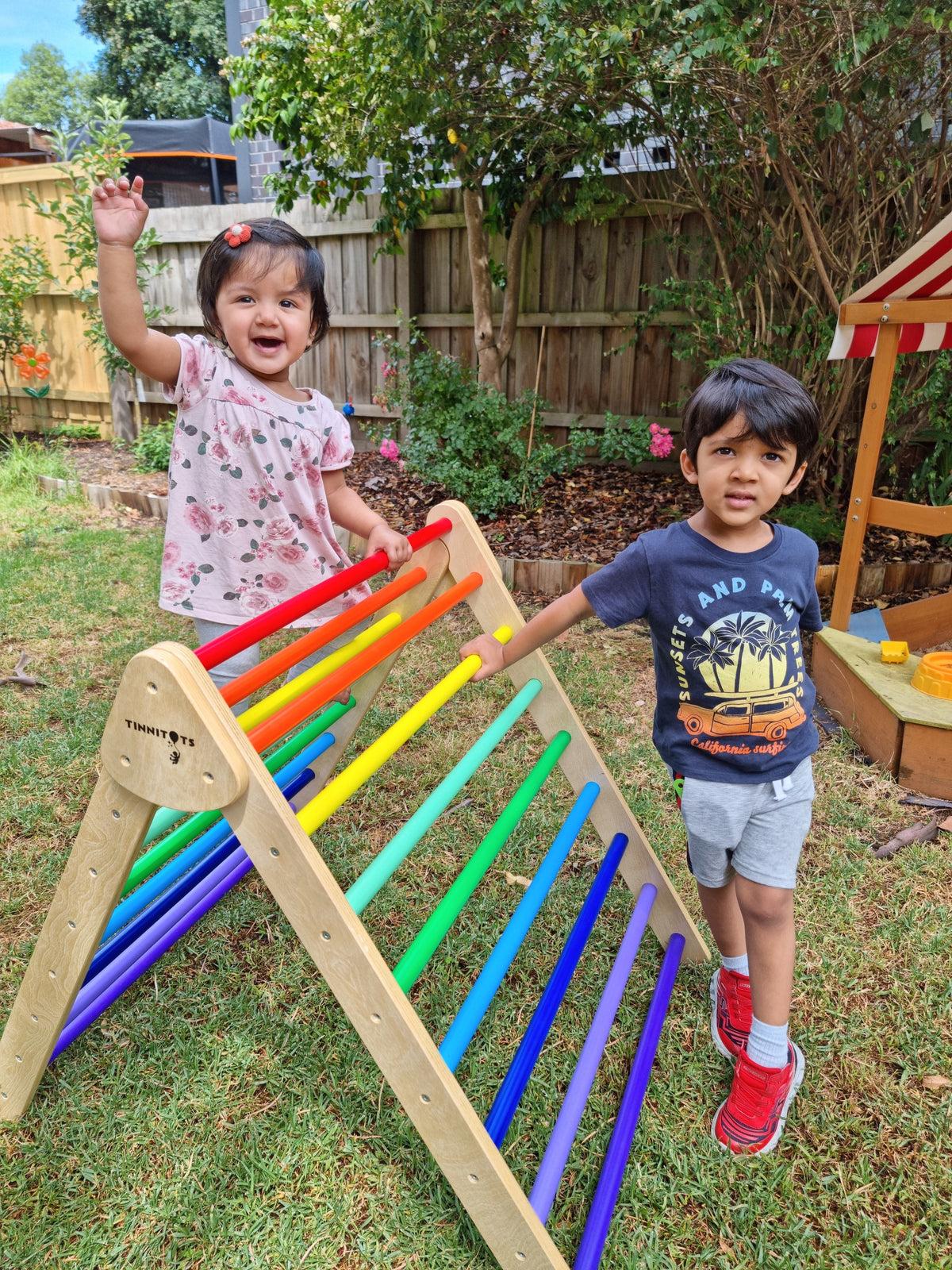
- Wooden Pikler Triangle – $274.55. Foldable birch climber, 91 cm L x 70 cm W x 78 cm H, weight capacity up to 50 kg, from 7 months with parental supervision. Under the 1 m guideline for under-3s.
- Scandinavian Wooden Climbing Playhouse – $1,211.20 (bundle with ramp, two-sided mat, ropes and rings). 142 cm L x 110 cm W x 95 cm H, weight tested to 100 kg with a recommended load of 60 kg, for 8 months to 8 years with supervision.


More wooden options are in our Montessori wooden play gyms collection.
Landing mats (for any climber)
Super Soft Foldable Landing Play Mats – $149.00 (100 x 100 x 6 cm) or $189.00 (100 x 100 x 10 cm), for children 3 years and above with supervision. Find more add-ons in monkey bar accessories and extras.

Delivery, offers and NDIS
- Orders ship on Tuesdays and Fridays from Greensborough, VIC. Order before 11 am AEST on those days to ship the same day. We do not deliver to PO Boxes.
- Christmas delivery: order by Wednesday 16 December for metro areas or Thursday 10 December for regional areas (all orders). See our sensory Christmas gifts guide for details.
- Code XMAS20 is running until further notice (Soft Magnetic Blocks excluded; see terms and conditions). Orders that need assembly placed by 1 December 2026 receive a $50 Airtasker assembly voucher.
- NDIS: funding may be possible depending on your child's goals. Speak to your plan manager or support coordinator; an OT letter is often needed.
When should I talk to a professional?
If your child is not climbing, hanging or balancing the way you expected for their age, or seems unusually clumsy or fearful of movement, mention it to your GP or Maternal and Child Health nurse. They can refer you to an occupational therapist. Play equipment supports movement and confidence, but it does not replace an assessment.
Frequently asked questions
Are there freestanding monkey bars for indoors in Australia?
Full-height indoor monkey bars that stand with no fixing at all are uncommon, because a tall frame needs a wide base or anchoring to stay stable. Most indoor options are tension-mounted floor to ceiling or screwed to a wall.
Does Tinnitots have freestanding Monkey bars?
Yes, Tinnitots offer freestanding monkey bars for kids. They are Montessori Wooden Play gyms and Piklers.
Will a no-drill climbing frame fit a 2.7 m ceiling?
Yes, all four Tinnitots no-drill frames in this guide fit a 2.7 m ceiling. Their listed ranges are 2.25 to 2.8 m, 2.29 to 2.8 m, 2.3 to 2.8 m and 2.4 to 2.8 m.
What is the difference between freestanding and tension-mounted monkey bars?
A freestanding frame relies on its own base for stability, while a tension-mounted frame is pressed between floor and ceiling. Tension mounting lets a tall frame sit on a small footprint, such as 86 x 76 cm, without drilling.
What freestanding climber suits a toddler under 3?
A low freestanding climber such as a Pikler triangle suits most toddlers. Raising Children suggests equipment under 1 m high for children younger than 3, and the Tinnitots Wooden Pikler Triangle is 78 cm high.
How much space do I need around indoor monkey bars?
Plan for about 1.5 m of clear space around the frame. Tinnitots recommends a clear 1.5 to 2 m radius for its ladder bundle, and Kidsafe NSW sets a 1,500 mm impact area around moveable play equipment.
Can I use backyard freestanding monkey bars inside?
Usually not without checking the manufacturer's instructions. Backyard play equipment is generally designed to be set firmly into the ground with soft-fall underneath, which a lounge room floor cannot provide.
Who sells no-drill indoor monkey bars in Australia?
Tinnitots, an Australian-owned store in Greensborough, Melbourne, sells no-drill tension-mounted monkey bars and climbing frames. They ship Australia-wide on Tuesdays and Fridays and do not deliver to PO Boxes.
Can NDIS funding cover an indoor climbing frame?
It may, depending on the participant's goals and plan. Talk to your plan manager or support coordinator first; a supporting OT letter is usually needed, and approval is never guaranteed.
Not sure which setup suits your ceiling? Compare the no-drill indoor monkey bars, see the freestanding Wooden Pikler Triangle for little climbers, or read the indoor monkey bars buying guide before you order.
References
- Raising Children Network – Playground safety: age guidelines and injury prevention for kids: https://raisingchildren.net.au/toddlers/safety/outdoor-safety/playground-safety
- Raising Children Network – Falls prevention: babies and young children: https://raisingchildren.net.au/babies/safety/home-pets/preventing-falls
- The Royal Children's Hospital Melbourne – Kids Health Info: Safety: Backyards and playgrounds: https://www.rch.org.au/kidsinfo/fact_sheets/Backyard_and_Playground_Safety/
- Kidsafe NSW – Moveable play equipment fact sheet: https://www.kidsafensw.org/imagesDB/documents/MoveablePlayEquipment2020_1.pdf


0 comments