

I cannot forget the day my five-year-old daughter sprinted toward the monkey bars at our local playground, full of excitement. She'd been talking about it all morning.
But just as she reached up for the first rung… the sky opened up.Typical Melbourne.

One minute sunny, the next minute pouring. Within seconds, the equipment was soaked, the ground was slippery, and every parent exchanged that look: playtime's over! We packed up and went home, and the disappointment in her eyes, broke my heart.
And that wasn't a one-off!!!
How many times have we said: "Maybe tomorrow, the weather might be better…"
Only for the wind, rain, or surprise cold snap to strike again?
The problem isn't that our kids don't want to play. It's that Melbourne weather keeps cutting them off. And it's taking a toll.
The stats in Australia are honestly scary:
• Only 31% of kids aged 5–8 meet daily activity guidelines
• That drops to just 14% for ages 9–15
The research is clear: monkey bars are exactly what our kids need. They build:
✅ Grip and core stability
✅ Coordination and balance skills
✅ Resilience and confidence

But how can they build those skills…if the weather keeps stealing their chance to practice? Maybe the real issue isn't motivation. Outdoor play in Melbourne is no longer reliable.
It's not laziness. It's not a lack of interest.
The problem is that our kids are spending more time waiting for good weather than engaging in physical activity. And that's when it hit me:
What if the monkey bars didn't have to wait for perfect weather?
What if the playground could come to us: rain, wind, or shine?
That one thought was the driving force behind the indoor monkey bar range.
Indoor Monkey Bars vs Outdoor Monkey Bars: The Decision Every Parent Eventually Faces
Suppose you've ever watched your child light up at the playground monkey bars. In that case, you already know why you're even considering buying your own set. The only real question becomes:

Do I get indoor or outdoor monkey bars?
On paper, it sounds simple. In reality? It's a surprisingly emotional choice.
Let me explain.
The Outdoor Monkey Bar Dream… and Reality
Most of us start with the same thought:
"Outdoor monkey bars are bigger, tougher, more like the playground… so they must be better, right?"
And yes: outdoor monkey bars come with some big advantages:
✅ More space → longer bars, climbing frames, full obstacle setups
✅ Built to be heavy-duty and long-lasting
✅ Perfect for big energy and backyard play
✅ Fresh air, sunshine, Vitamin D

But then reality sets in…
❌ "Four seasons in a day" Melbourne weather
❌ Rain makes them slippery and unsafe
❌ Winter = too cold, Summer = burning hot bars
❌ Kids lose confidence when they only practise once every 2 weeks
❌ You need the space (goodbye lawn!)
❌ Council / neighbours / installation headaches

And here's the thing no one tells you:
"Outdoor monkey bars only work IF your child actually uses them consistently"
And with our weather? Consistency is the first thing to go.
Enter Indoor Monkey Bars
Most parents don't even think about indoor monkey bars at first. It feels… extreme. Like, who puts monkey bars in their living room?
But then you realise something:
Your child doesn't need "big." They need "accessible."
Indoor monkey bars flip the whole game:
✅ Use them every day: rain, wind, heat, whatever
✅ Build strength and coordination through repetition
✅ Perfect height for younger kids (less fear, more confidence)
✅ Safe, padded, supervised play
✅ Great for apartments or small homes (yes, really!)
✅ Doubles as sensory play / creativity / imagination space
✅ Weather-proof = motivation-proof
"But are indoor monkey bars actually worth it?"
If your goal is skill development, confidence, and consistency: then YES.
Outdoor bars build toughness. Indoor bars build ability.
One lets them swing far. The other lets them try again… and again… and again… until they master it.
Indoor Monkey Bars Pros vs Cons
✅ Indoor Monkey Bars – Pros
-
Use any time (weather-proof)
-
Safe and height-appropriate
-
Builds consistent practice habits
-
Great for strength, coordination, sensory play
-
Encourages independent play
-
Ideal for younger or less confident kids
-
Offers years of uninterrupted 365 Days Play
❌ Indoor Monkey Bars – Cons
-
Limited size (less "extreme" play)
-
Needs at least 1m space inside (living room, playroom, spare room)
-
Does not give a playground appeal hop from one to another.
-
You will need to set it up (it’s a one time thing but it’s still work)
Outdoor Monkey Bars Pros vs Cons
✅ Outdoor Monkey Bars – Pros
-
Bigger, more challenging
-
Feels like a "real" playground
-
Built to last for years
-
Frees up indoor space
❌ Outdoor Monkey Bars – Cons
-
Kids lose interest if they can't use it often
-
If its like Melbourne weather = play depends on the forecast
-
Risk of rust or weather wear
-
Can be slippery or unsafe when wet
-
Takes up backyard space
So… Which Should You Choose?
Ask yourself one simple question:
Do I want my child to have fun sometimes, or do I want them to progress consistently?
✅ If you want occasional fun and adventure→ Outdoor
✅ If you want skill-building, daily use, Returns of your investment and a guaranteed play → Indoor
✅ If you want the best of both → Start with indoor (confidence + strength), then upgrade to outdoor once they're ready
Because here's the truth…
Monkey bars are more than play equipment.They're confidence machines.
And confidence isn't built in sunshine.It's built in repetition.
Outdoors challenges them. Indoors prepares them.
And when you combine the two?
That's when they fly past the second rung… and never look back.

Space & Location Constraints (a.k.a. “Where do I put these?”)
One of the biggest worries parents have before buying indoor monkey bars isn’t safety or price: it’s space.
Do I even have room for this? Totally fair question. Let’s break it down.
How much space do indoor monkey bars really need?
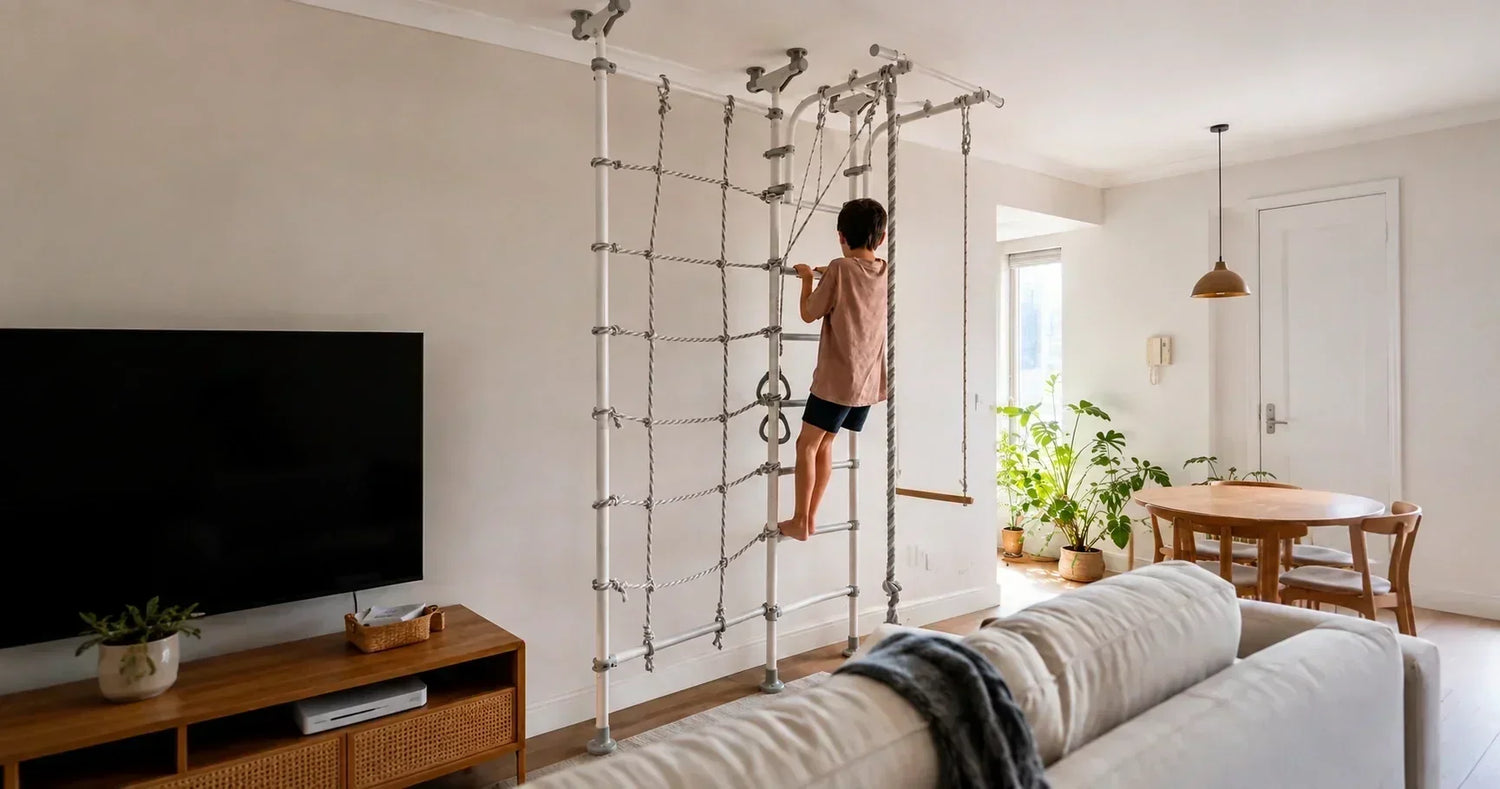
Here’s the good news: indoor monkey bars don’t need a massive playroom.
They can start from as little as 1 sqm space and can be extended upto 12 sqm!
If your child can lie down on the floor and stretch out, you probably have enough space.

Can these indoor climbing frames fit in a small room?
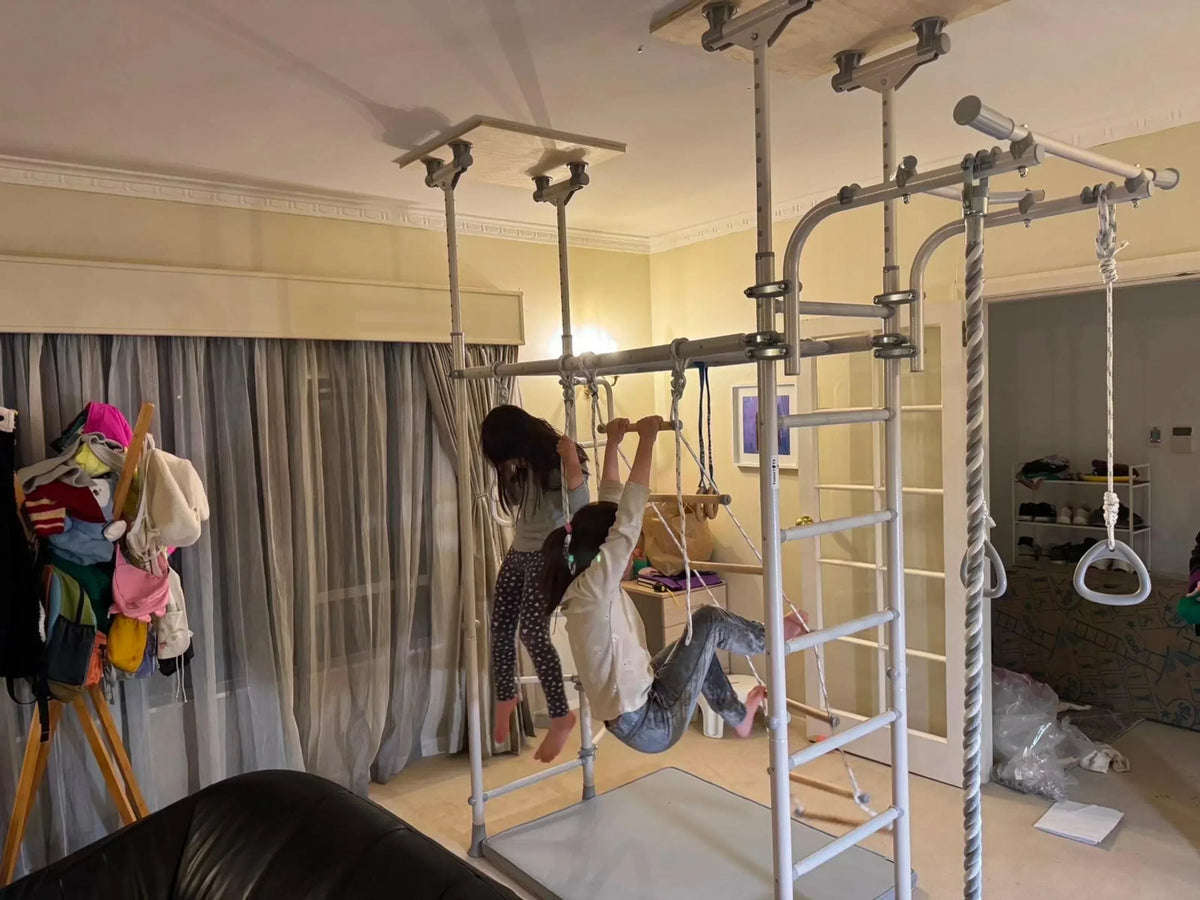
Yep. The clever part is that many indoor sets are compact, modular, or even foldable.
Parents put them in:
-
Bedrooms

-
Playrooms

-
Spare rooms

-
Garage
-
Man Cave / Basement
-
Corners of living rooms
-
Even hallways (yes, really!)
It’s less about room size and more about smart layout.
Do I need high ceilings for these indoor play gyms?
Not necessarily. Most indoor monkey bars sit between 2.25 to 2.8m, perfectly fine for standard ceiling heights in Australian homes (usually 2.4m).
And even if your ceilings are a bit lower, there are low-height or adjustable options specifically made for younger kids.
And if you have High mansion like ceiling of upto 3m, some models can be modified to cater to high ceilings too.
Can I put these indoor climbing frames on the carpet?
Absolutely. Carpet actually adds extra cushioning and grip, making it a great base.
But our indoor climbing frames also work on:
-
Floorboards
-
Tiles
-
All types of flooring
Just make sure the frame is stable and level: and if you’re worried, add a play mat underneath for peace of mind.
Can I use these indoor play gyms in an apartment?
100%. Indoor monkey bars exist because backyards aren’t always an option. Apartments are actually a perfect use case: especially for active kids with limited outdoor access. Look for:
-
no drill options - very rental friendly.
-
Low-height frames
-
modular designs
Remember, space doesn’t have to be a deal-breaker when it comes to indoor monkey bars. With a bit of creativity and the right set, you can provide your kids with a fun and active play area, even in a smaller home.
Outdoor monkey bars demand a big backyard and perfect weather.
Indoor monkey bars just need a couple metres, a standard ceiling, and a kid who loves to climb.
If you can fit a bookshelf or a small sofa… you can probably fit monkey bars. And honestly? That tiny corner of your home might just turn into the most used space in the entire house.
Safety & Risk Differences: Indoor Monkey Bars vs Outdoor Monkey Bars
Let's be honest: every parent has the same fear:
"What if they fall?" So before anything else, we ask: Are indoor play gyms actually safe?
The short answer: Yes: often safer than outdoor monkey bars.
Indoor = Controlled Environment
Indoor play gyms are designed for home use, which means:
✅ Height Adjustable (Customise based on your need so less impact if they fall)
✅ Softer flooring (carpet, mats, rugs)
✅ No rust, sun damage or slippery surfaces
✅ No strangers or crowded playgrounds
✅ You can supervise easily
And because they're right there in your home, you can catch unsafe behaviour early and teach proper technique.
Outdoor = More Risk and the data backs it up.
Are outdoor monkey bars more dangerous? Unfortunately: yes. Why?
❌ Taller heights → harder falls
❌ Hard ground (dirt, bark, concrete)
❌ Wet or muddy surfaces → slippery
❌ Rusted or loose bars → unstable
❌ No shade → UV, heat, dehydrated kids
❌ Busy playgrounds → collisions with other kids
Which has more injuries?
Studies consistently show the risk of fall from monkey bars was twice the risk for all climbing-frames. Indoor play gyms are rarely the cause of serious injury because they're lower, softer, and More supervised.
Do indoor climbing frames need mats underneath?
Highly recommended.
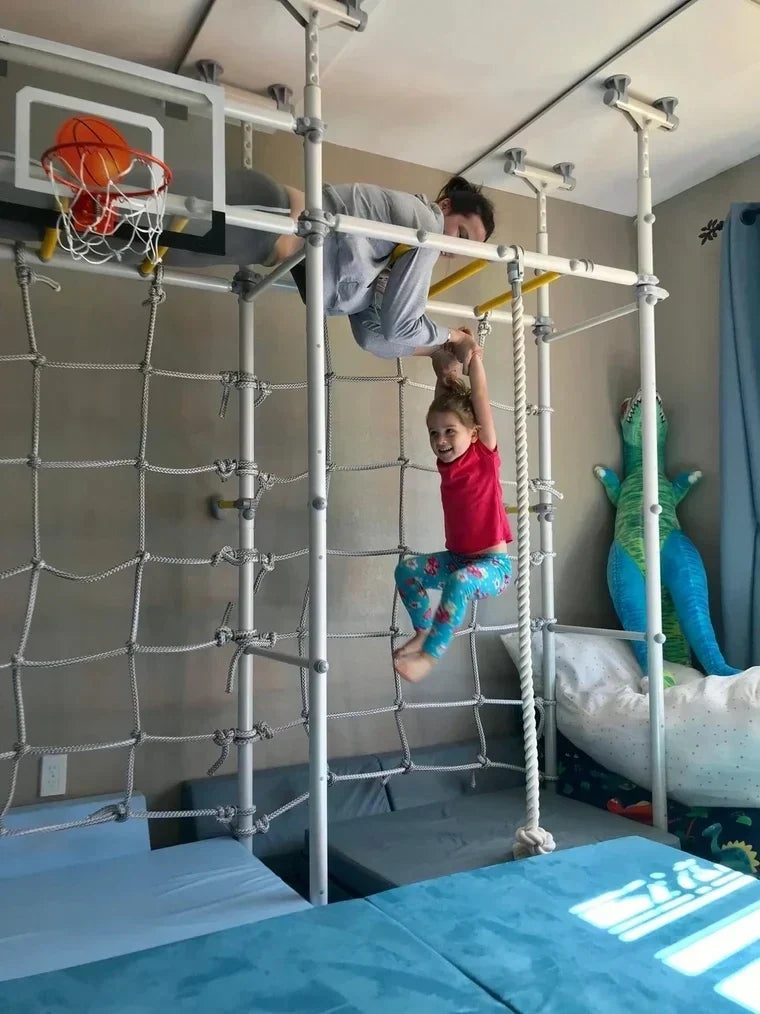
Even though indoor frames are lower, adding crash mats or foam flooring:
✅ Cushions fall
✅ Reduces noise (neighbours love this, especially in apartments)
✅ Gives kids confidence to try new skills
Think of mats as seatbelts: Most of the time, you don't “need" them, until you do.
Weather = The Silent Safety Factor No One Talks About
Outdoor play comes with weather risks we often ignore:
🌧️ Rain → slippery bars, muddy ground
☀️ Heat → burning hot metal bars, dehydration
🌞 Sun → UV exposure, sunburn
🍃 Wind → dust, branches, flying debris
🌦️ Sudden weather change → cold, wet, unsafe
🦟 Mosquitos → Can’t fully prevent your child's tender skin from getting pricked all over
Indoor play?
Same temp. Same Comfort. Same conditions. Every day.
Predictable = safer.
Kids will climb. The question is:
Do you want them climbing in a safe, controlled environment… or on wet metal bars in a windy park with concrete underneath?
Indoor play gyms don't remove adventure. They remove unnecessary risk and that's Smart Parenting.
Common Questions from our Customers
Can I take indoor monkey bars if I move house?
Absolutely and this is one of the biggest advantages of indoor monkey bars. In most cases, you can simply disassemble, pack, and reinstall them in your new home, just like furniture.
Are indoor monkey bars good for keeping kids active indoors?
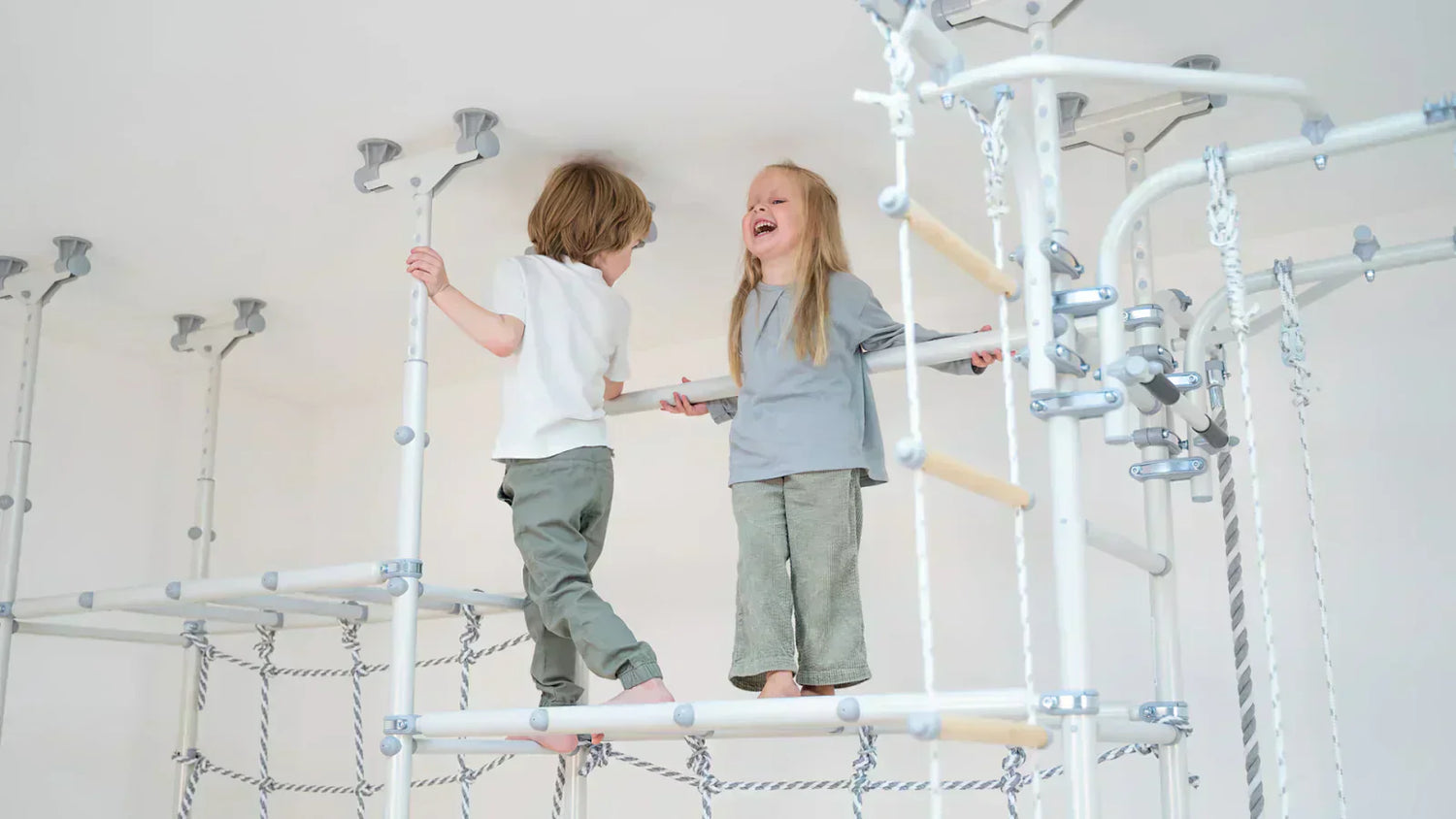
Indoor monkey bars give kids a way to climb, swing, hang, stretch, and burn energy every single day, regardless of weather. They build real strength, coordination, grip, and confidence.
For active kids, indoor monkey bars are like having a mini playground and gym in your home.
Can indoor monkey bars blend with home decor?
Modern indoor monkey bars are nothing like the bright plastic eyesores you might be imagining.
✅ Neutral colour choices / timber frames
✅ Scandinavian/minimalist styles
✅ Montessori-inspired designs that look like furniture
They can look stylish, intentional and even add character to a room.
Do indoor bars become slippery from sweat?
One of the biggest advantages of indoor monkey bars like these is the textured, non-slip surface. The raised bumps give little hands (and feet!) something to latch onto, so kids don’t have to rely on pure strength, making it easier to hold, hang, and swing with confidence.
Kids get sweaty when they play, especially indoors where they use the bars more frequently. Unlike smooth metal bars that become slippery, this textured surface maintains grip even with moisture, reducing the risk of slipping or falling.
At first, indoor monkey bars sound like a luxury. But when you really look deeper, they’re actually one of the smartest investments you can make for your child’s development.
✅ They remove the biggest barrier to play: weather
✅ They turn unused space into a confidence-building zone
✅ They encourage daily movement, strength, and coordination
✅ They keep kids off screens: without you having to nag
✅ They’re safer, lower to the ground, and easier to supervise
✅ They fit apartments, houses, playrooms, bedrooms, etc
✅ They’re moveable, customisable, and can even look beautiful in your home
✅ They help reduce buying one time eye catching toys which then goes straight to bin.
Monkey bars build more than muscles: they build resilience.
And resilience doesn’t come from trying something once a week at the park. It comes from trying again and again, in a safe space, until you finally reach the next bar.
Indoor monkey bars don’t replace outdoor adventure. They prepare your child for it.
0 comments